Restaurant Marketing Strategies: The Ultimate Restaurant Marketing Guide (2026)
We cover must-have details for your restaurant marketing, including customer profiles, a marketing matrix and tactics to try.

- A strong restaurant marketing strategy includes more than just promotions—it’s about aligning product, place, price and promotion.
- Understanding your ideal customer through buyer personas helps you target the right audience and maximize marketing impact.
- Local SEO and smart pricing strategies can drive more foot traffic and online orders without wasting your budget.
- The most successful promotions are data-driven, tailored to your audience and designed to create repeat customers.
Restaurant marketing is your key to attracting more customers, increasing sales and building a loyal following. With countless dining options in your city, you need to stand out—and a few flyers won’t cut it.
We’ve helped thousands of restaurants drive over $100 million in sales and learned what truly works. In this guide, I’ll walk you through a proven restaurant marketing strategy to:
💡 Think about restaurant marketing advertising in a way most overlook.
🗑️ Stop wasting money on restaurant marketing tactics that don’t pay off.
📈 Build a restaurant marketing strategy that drives results.
This is the same approach we’ve used to help restaurants grow for years, boosting their online orders by an average of 270% in just 90 days.
Let’s get started.
What is Restaurant Marketing?
Restaurant marketing is a key component of your restaurant business plan. It spreads the word about your food and customer experience, but real results take more than an #InstaFood post.
Promotions matter, but without a clear restaurant marketing strategy, they won’t get you far. That’s where a restaurant marketing frameworks come in.
Let’s break it down using the four P’s: product, place, price and promotion. This framework helps you build a smart marketing strategy based on your restaurant’s strengths, market and goals.
Here’s a quick overview—we’ll dive deeper soon.

If you don’t use a restaurant marketing framework, you risk investing in promotional tactics that just waste your time and money. In our experience, that is a major mistake you don’t want to make.
Why do you need a restaurant marketing strategy?
Marketing is not just promoting your restaurant, which is a common pitfall I’ve seen owners stumble into time and time again.
A proper restaurant marketing strategy includes all of the four Ps we mentioned earlier, not just promotion. Here’s a simple example of how each P impacts your marketing:
- Product: What makes your restaurant's food different, and what do customers love? Use this in your messaging.
- Place: Who has access to your restaurant and would enjoy the vibe? Consider how you can reach these specific customers.
- Price: How does your menu pricing compare to competitors? How much is too much for your target customer? This can narrow your customer base or apply to your promotion strategy.
- Promotions: Instead of deciding that untested coupon mailer strategy will definitely work, focus your efforts (and marketing budget) on who you’re trying to reach and why.
If you want to use this restaurant marketing framework properly, you need to know more about your target audience to speak directly to their needs. Otherwise, you won’t know how to convert them into customers and increase your sales.
The best place to start is by creating your own customer personas.
{{cta-1}}
What to do before building a restaurant marketing strategy
Before you get into tactics and campaigns, you need to spend some time laying the foundations. This includes:
- Defining your target customer and personas
- Undestanding the 4 P's of marketing
- Make sure you have a great website for your restaurant
That's where we'll start here in this guide.
Who is your customer? Build personas for your restaurant
You need to know who you’re talking to for effective restaurant marketing. Otherwise, you’re just throwing time and money at the wall, hoping something sticks, and that’s not consistent enough to be worth the effort.
To know your customers, what they want and how you can satisfy them, start by identifying these traits and behaviors:
Demographics:
- What’s the average age of your customers?
- Does your customer base skew towards a particular gender identity?
- How much money do your guests make?
- Are you more popular with locals, tourists or both?
- Do you typically serve friend groups, couples or families?
Behaviors:
- When do you customers typically visit?
- How often do customers return?
- How much do they spend on average?
- What are their favorite menu items?
- How long do they spend in your restaurant?
Your POS system or online ordering system likely collects customer data you can pull from to make this easy. Validate your findings with your restaurant manager and servers that see guests day-to-day.

An example persona details your target customer’s needs, habits and communication preferences so you can effectively reach them with marketing.
After identifying core habits, group them into buyer personas with key demographics and behaviors. This helps you craft targeted marketing and promotions.
A strong buyer persona includes:
- Persona: A named customer group with shared behaviors
- Likes & dislikes: Their preferences in dining experiences
- Behaviors: Common habits, like meeting for lunch
- Messaging channels: How to best reach them
Give each persona a memorable name to help your team personalize service and make smart upsell recommendations.
Target customers to save time
Buyer personas are so valuable because they create a restaurant marketing bullseye. You know exactly where to aim your efforts to craft a custom conversion strategy. It’s the secret to effective marketing without wasting your effort trying to appeal to everyone with little success.
So take your customer profiles a step farther. Once you’ve built your key customer personas, determine:
- Who’s most profitable?
- Who’s most loyal?
- Who’s easiest to reach?
The answer to these questions is your ideal target customer.
Center them when you finally dig into the marketing mix framework, which we’ll dive into next.
4 p’s of the restaurant marketing mix
The restaurant marketing mix framework helps you evaluate your restaurant’s strengths and positioning so you can tailor your marketing messages to grow your customer base, average sales and other goals for the year.
Most owners focus on promotions above all else, but each P in the marketing mix is a valuable part of your strategy. It might seem straightforward now, but there’s plenty more to cover below.
Product
Your product—food and service—is the heart of your restaurant marketing. This includes your menu, dining experiences, events and services like online ordering.
Be specific about what sets you apart. A well-executed or unique offering drives word-of-mouth, social shares and repeat visits. If you're one of many comfort food spots but the only one with seasonal farm-to-table ingredients, that’s a competitive edge.
.png)
Use these questions to refine your unique value:
- What’s your concept and specialty?
- How do you serve and prepare food?
- What dining options, events or experiences do you offer?
- What defines your ideal customer experience?
Advertise what you do best—highlight top sellers, showcase specialties online and personalize marketing based on customer personas. If Adventurous Alice loves bold flavors, promote seasonal dishes over happy hour specials.
Your goal: Find your product-market fit. Identify what’s in demand and where you fit in, and make that the core of your marketing message.
Place
Your location and service area are major considerations for your restaurant marketing strategy that are easy to gloss over. You want to target locals — otherwise, your great messaging doesn’t really matter.
For example, social media seems like an obvious choice, but it’s a trap. You can have 100,000 global followers who like all of your posts, but they’re not coming in for dinner. So how do these followers benefit you at the end of the day?
.png)
It’s not easy to make changes to your physical real estate, but your digital presence can still boost your IRL foot traffic. In fact, most of your customers are looking online to find the new hot spot in town instead of walking down Main Street.
So, how do you target your local audience online?
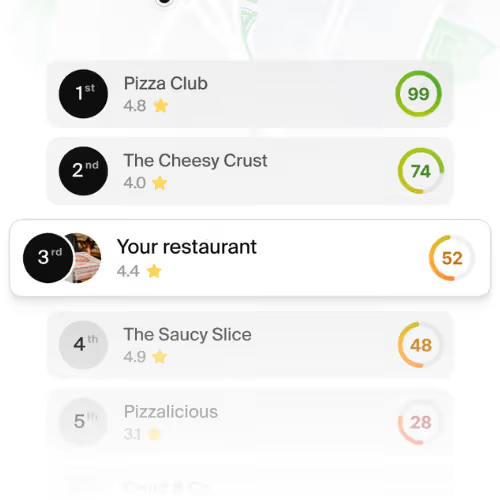
Tap into the power of restaurant search engine optimization (SEO). If you’re unfamiliar, SEO is how you can get your restaurant and menu to the top of Google search results so your audience easily finds you. For advanced SEO tactics, learn more about local SEO for restaurants.
SEO is our specialty and we’ve seen how transformative it is for small businesses. Just read how Rahul, owner of Saffron Indian Kitchen, earns 700 new customers a month from Google.

Include your product, place and restaurant names in keywords to attract local diners already searching for what you offer.
How? Because his site is optimized to rank for relevant keywords, including their top menu items and localized phrases like “best Indian restaurant in PA.”
Getting started with SEO might feel intimidating, but we have plenty of resources for you, like this guide to getting your restaurant to rank #1 on Google. It’s well worth the effort and one of our favorite marketing tactics for independent owners like you. Learn more about how Owner can help you win with Restaurant SEO.
Price
Price impacts both your profits and customer appeal. If pricing doesn’t match quality and expectations, even the best restaurant marketing won’t help. But, a smart pricing strategy can attract new customers and boost sales.
Profitability first:
- Which services (breakfast, lunch, dinner) are most profitable?
- What menu items drive the most revenue?
- What days and seasons bring in the most sales?
Use this data to target slow periods. If Wednesday lunch is dead, a two-for-one deal or happy hour special can bring people in. Sometimes, adjusting pricing is more effective than printing new flyers.
.png)
Pricing from the Customer’s Perspective:
- Are your prices affordable, premium or just right?
- How do they compare to competitors?
Finding the sweet spot—profitable for you, fair for customers—is key. Buyer personas can guide this. If your guests value deals, try a Date Night Dinner Special: a free appetizer with two entrees and drinks. This approach will help drive higher check sizes while keeping costs in check.
Promotion
Finally, the moment you’ve been waiting for — let’s chat about promoting your restaurant. This is ultimately how you reach target customers and what you offer them.
.png)
We’ve seen some amazing promotions that grow customer bases and increase sales, and there’s one thing they all have in common.
A well-fleshed-out strategy is your marketing BFF, so if you skipped ahead to this section, back up and check out the rest of the post. And if you’re looking for promotional tactics, you can jump ahead.
Your buyer personas play a significant role here, too:
- How does your target market like to be reached? Online, in-person or directly?
- What motivates your customers? Are they more likely to come through for a new chef’s special or too-good-to-be-true deal?
- How can you convince your ideal customer to try your restaurant? Real reviews, local features and product photos can help.
Applying this to your customer personas might look like:
Focus on what excites your customers, and they’re more likely to respond.
In many cases, you’ll find that digital marketing is bigger than ever nowadays. You’re better off with a custom mobile app on your customers’ phones than passing out flyers on the street. Not only does a promotion like “15% off your first app order” encourage new customers, but the easy-to-order mobile app and notifications encourage diners to keep coming back.
Don’t overlook the importance of converting a regular, which is far more valuable than a new customer that might order once. So keep up your email marketing and loyalty programs to reach past customers directly and give them something to look forward to.
Social proof is important, too. This is where review sites like Yelp come in. It’s particularly valuable when you’re trying to build trust with new customers. You can talk about how much you love your food, but honest word-of-mouth promos are hard to beat — even in the digital age.
In fact, Yelp is the second largest source of new customers for restaurants, and we have a YouTube video to help you get started here.
Create a great restaurant website
If you don't already have one, a great restaurant website is essential for having success as a restaurant. Your website is the foundation every other marketing channel points back to. When a diner discovers you on Google, Instagram, or a review site, your website is where they land to see your menu, decide, and order — so it needs to load fast, look great on mobile, and make ordering or delivery effortless. Unlike a social profile or a third-party app listing, your website is an asset you fully own and control, which makes it the single highest-ROI place to invest your marketing effort.
Most importantly, a website with direct online ordering turns marketing traffic into revenue you keep. Every order placed on your own site instead of a third-party marketplace means no 25–40% commission and, just as valuably, a customer relationship and set of data you own — the email, the phone number, the order history you can market to again and again. That's what separates marketing that builds your business from marketing that builds someone else's. A restaurant-first platform like Owner gives you a fast, SEO-ready website with commission-free ordering built in, so the traffic you work hard to earn converts into direct, repeatable sales.
How to build a restaurant marketing strategy
At this point, you have all of the ingredients for a successful restaurant marketing strategy thanks to the four P’s marketing framework.
We’ve covered:
- The importance of creating a restaurant marketing strategy before investing in tactics
- How you can build customer personas
- How the marketing mix framework directs your restaurant marketing strategy considering your product, place, price and promotion
- Creating a great restaurant website
Now, you just have to follow the recipe and put it all together. But there are still some important details you need to know to create a fully-realized restaurant marketing strategy.
Use what you’ve gathered so far to finalize these key concepts below.
Restaurant marketing campaign goals
What are you hoping to achieve with this strategy?
Use SMART goals (specific, measurable, actionable, realistic and time-bound) and key performance indicators (KPI) to measure your performance.
Key performance indicators (KPI)
What are you measuring to determine the success of your restaurant marketing strategy?
Your KPI is directly tied to your goal. So, if you’re trying to increase your sales, your KPIs could be:
- Number of new customers
- Number of online orders
- Average daily profit
- Average ticket size
We’re putting together a solid restaurant marketing strategy overview here. But if you need a little more support, check out our restaurant marketing plan resource, too. This digs a little deeper into your Strengths, Weaknesses, Opportunities, and Threats analysis (SWOT) competitor analysis and budget breakdown.
Now that you’re clear on what you’re trying to achieve and have a little more direction, you can choose specific tactics that fit into your strategy. Check out some of our top tactics below.
Campaign timeline
How long will the campaign run?
Be specific about when your campaign will end and how each stage is broken down. Use a calendar to track both one-off tactics like local event tables as well as consistent messaging like email blasts.
A clear campaign timeline allows you to track your performance over time, see what’s working and what’s not, and revise your strategy to improve future outcomes. If you don’t know what you’ve done and how effective each step was, your marketing won’t improve and it will be a lot harder to grow your restaurant sales.
Restaurant Marketing Channels
What communication channels are you using to reach your audience?
This can be pretty broad, but the more specific you are, the better the payoff. Your options include everything from direct-mail flyers and local magazine ads to social media and Google ads.
Luckily, you determined your customers’ preferences when you built your customer personas. Always revisit your target customers, what they like and how to reach them when you get into the strategy specifics.
A lot of marketing ideas are floating around the internet, but what works for one owner won’t necessarily work for you. There’s no one-size-fits-all solution, so your marketing tactics have to make sense with your overall strategy.
I’m sure you can relate to spending a pretty penny on a local magazine ad or a social media intern without much to show for it. That’s why I’m such a stickler for custom tactics according to your customer targets and goals, so that every cent invested in your marketing is well spent.
SEO for Restaurants
You might not realize it, but your digital presence and website is as much of your “place” as your actual restaurant location. And just like you don’t want a restaurant on the edge of town with little traffic, you don’t want a restaurant website floating around in digital-no-man’s-land.
Every day, thousands of potential customers in your area hop on Google to find the best “Indian food near me,” and Google directs these searches straight to local restaurants.
People searching Google to find something to eat are the MOST primed to become a customer. So, how do you reach and convert these customers?
It all comes down to who has the best local SEO.

Restaurant SEO is the process of setting up your online brand, website, and individual website pages to show up in Google when people search for anything relevant to your business: your cuisine, food items on your menu or even just a list of great restaurants in your area.
Mastering SEO is complex, but you don’t need to become a master to benefit. Here’s the basic SEO guide for restaurants:
- Optimize your Google Business listing.
- Optimize your website and online menu.
- Get more reviews on sites like Yelp as well as direct reviews for your site.
“Optimize” is just the steps to improve each feature specifically for search. The gist is that you want to provide as much information as possible about your business, including your brand, menu, location, etc.
Especially considering your target customers and how your product appeals to them. If you want Adventurous Alice to place an order, you need a well-designed site that promotes your top-sellers and specialty flavors on your homepage and online ordering platform.
Email marketing for restaurants
Email marketing is incredibly effective for restaurants because it’s fairly easy to get email signups, and you can expect around 30% of your email subscribers to open any email you send out.
Working with thousands of restaurants over the last few years, I’ve found that two emails per week are the ideal frequency for the average subscriber. That means I want every single customer on your email list to hear from your restaurant at least twice per week, even if they don’t order anything from you.
I have a few favorite emails to send:
- Prompt email: A simple invitation that promotes your restaurant and gets your brand on customers’ radars.
- Loyalty reminder: Let guests know that they have points available to redeem.
- Popular items: Promote your best-selling products to encourage a new order.
It’s worth the investment. Research estimates that for every $1 you invest in email marketing, you can expect a $36 ROI. This is especially important when you’re trying to convert customers into regulars, which is far a more valuable and effective promotion than trying to get net new customers.

Learn moire about the 8 proven restaurant email marketing campaigns to drive more sales.
SMS marketing for restaurants
In terms of performance, text marketing is like email marketing on steroids. Customers will open over 85% of texts you send them and click on text offers significantly more often than email based on offers.
The downside is that fewer people are willing to receive marketing texts, and those who do won’t want to be sent texts very frequently. I recommend only texting your customers twice per month.
That also means it’s extra important that your texts target your customers interests and behaviors. If you’re promoting happy hour time and time again, but most of your customers don’t order from the bar, you’re wasting your time.
We send out all of these texts and emails for restaurant partners using Owner.com, but you can send these yourself using any of the email service and text marketing providers.
It takes some time to get everything written and set up, but out of everything in this guide, email and text marketing are probably the simplest to set up yourself.
Loyalty programs for restaurants
You’re probably familiar with loyalty programs and might already have one in place, but is it as effective as it could be?
Helping our restaurant partners build a strategic, intentional loyalty program, supported through technology with automated offers and updates, is the single biggest reason our partners grow an average of 50% in their first 90 days with us.
- Encourage repeat customers with personalized product promotions.
- Collect customer data to build customer personas and communicate directly.
- Increase sales with rewards points that incentivize larger orders.
Learn more about the 11 best restaurant loyalty campaigns that drive sales.
Instagram for restaurants
There are a lot of social media platforms out there, but if you aren’t running paid marketing campaigns, the only platform that truly matters for restaurants is Instagram.
Restaurant customers respond overwhelmingly to visual marketing, and Instagram makes it very easy to get visuals of your products, including food, setting, brand, events, etc., directly in front of local customers. That's why we think it's so important for restaurants to build their own Instagram marketing strategy.
“Local” is the keyword here. Targeting local customers builds social media as part of your digital “place” rather than just a public photo album.
If you’re active on Instagram and follow a few easy steps outlined in this section, you will get in front of real, local customers. That means you won’t need 100k followers to make $100k extra revenue through Instagram.
That said, you should prioritize some of our other fave tactics before investing too heavily in Instagram.
Talkin’ Tacos completed $262,000 in online sales within 11 months with just 24,000 Instagram followers at the time. Their key to success?
Posting food photos 4-5 times a week with relevant hashtags. That’s it. No sneaky marketing here, and it’s just one part of our Instagram playbook for restaurants:
- Post your food several times a week
- Post Stories and pin your Story highlights
- Repost customer photos you’re featured in
- Follow your competitors’ followers
- Create a simple “selfie station” to drive user-generated content
- Coordinate promotions with your social media posts
If you’re concerned about keeping up with fresh photos, find someone on your staff who enjoys social media and pay them an extra $100 per week to post pictures of your products and quick little stories throughout the day. Just keep an eye on things to ensure everything goes through the restaurant account and is appropriate.
To learn more about how to drive more orders from social media, check out our Ultimate Guide to Restaurant Social Media Strategy.
Delivery flyers for restaurants
Digital marketing is more important than ever, but nondigital efforts still have an important role to play in your growth. Our team has found massive wins for our partners using physical marketing, and delivery flyers are the most successful.
For each of our restaurant partners, we design, print out and send 1,000 flyers for them to place in pickup and delivery orders. This is a very simple step that can have shocking results. It promotes your online ordering “place” and encourages repeat orders while building brand recognition with customers.
Win and keep guests: reviews & reputation
If your restaurant marketing strategy is working, you'll be getting lots of feet in the door, online orders, and your sales will grow. One of the best marketing strategies for restaurants is leveraging your existing, satisfied customer base to market for you!
Online reviews are one of the rare marketing assets that work double duty: they're both social proof and an SEO signal. Before a diner ever visits, they check your star rating; a strong, recent set of reviews is often what tips them from "maybe" to "let's go now!".
At the same time, Google treats review volume, recency, and quality as a core local ranking factor, so the same reviews that win over customers also push you higher in the map pack and "near me" searches. That's why reputation isn't a set-it-and-forget-it task. It's an ongoing channel that compounds, driving both visibility and trust every month you invest in it.
The playbook is simple: consistently ask happy guests for Google reviews (the ones that move rankings most), make it effortless with a QR code or a post-order text or email, and respond to every review (good and bad )since Google and future diners both reward restaurants that engage. Doing this by hand is where most restaurants fall behind, which is why automating it matters. Owner's Reviews Engine automatically requests reviews from customers after they order, so your Google rating keeps climbing without extra work.
How to measure your restaurant marketing strategy
Great restaurant marketing isn't about doing everything, it's about knowing what's actually driving results and doubling down on it.
Start by tracking the metrics that tie directly to revenue:
- website traffic and where it comes from
- online orders and average order value
- repeat-order rate (the clearest sign your marketing is building customer retention, not just one-time visits)
From there, layer in the two numbers that separate guessing from strategy: return on investment for each channel, and customer lifetime value (CLV) — how much a guest is worth over months and years, not just their first order. CLV is what justifies spending to acquire a customer, because a $15 first order can become hundreds in repeat business when your marketing keeps them coming back.
The harder question is attribution: knowing which channel actually drove each sale.
This is exactly where owning your customer relationship pays off. When diners order directly through your own website instead of a third-party app, you can see the full journey: which campaign, email, or search brought them in, what they ordered, and whether they came back. That first-party data lets you connect a specific marketing dollar to a specific sale — something you simply can't do when a marketplace sits between you and your customer. Platforms like Owner surface these metrics in one place, so instead of marketing on instinct, you can see what's working and put more behind it.
Restaurant marketing: where and how to start?
All the strategies in this guide only work when they add up to a plan you can actually sustain.
The simplest framework: pick your top goal for the quarter (more first-time orders, more repeat visits, a bigger email list), choose two or three channels that map to it, and build a lightweight marketing calendar so nothing slips.
A workable rhythm looks like this:
- Daily: respond to reviews and engage on social
- Weekly: post content and send one email or SMS to your list
- Monthly: refresh your Google Business Profile photos and posts, review your metrics, and plan a promotion or event
- Seasonally: run a bigger campaign around a holiday or menu launch.
Written down and repeated, that cadence beats sporadic bursts of effort every time.
If you only have a few hours a week, don't try to do all of it. Start where the ROI is highest and the lift is lowest. In order: make sure your website and direct online ordering are solid, claim and optimize your Google Business Profile, and turn on automated reviews and email/SMS so your marketing runs even when you're on the line.
Those three cover discovery, conversion, and retention with mostly set-it-and-forget-it effort. The foundation everything else builds on once you have more time. For a step-by-step walkthrough and a template you can copy, see our full guide on how to create a restaurant marketing plan.
How Owner can help market your restaurant
Our restaurant marketing platform automates your digital marketing with effective tactics that have helped thousands of restaurants, including a custom website with SEO built in, online ordering and delivery made easy, a branded loyalty program, mobile app and automated email and SMS marketing.
If you want a proven restaurant marketing strategy without all of the work, consider partnering with Owner.com—try out a free demo today.
Restaurant Marketing Strategy FAQs
What are the 4 Ps of restaurant marketing?
The 4 Ps of restaurant marketing are product, price, promotion, and place. Together, they form the foundation of any effective marketing strategy.
- Product: The food, drinks and overall dining experience. A strong product is the starting point for everything else. No amount of marketing will drive lasting results if the experience doesn't deliver.
- Price: Pricing communicates value and shapes who walks through the door. It should reflect the product's quality, the target audience's budget and what competitors in the area are charging.
- Promotion: Everything used to get the restaurant in front of potential customers, including social media, email, SMS, SEO, loyalty programs and paid ads. Every promotional effort should tie back to a clear goal.
- Place: Where and how customers access the restaurant. This includes the physical location, online ordering, delivery platforms and the website. The easier it is to find and order, the better.
How much does social media restaurant marketing cost?
Social media marketing can cost as little or as much as you want. If you’re handling content yourself, your main investment is time. If you’re running paid ads, even a small budget (like a few dollars a day) can drive results if your targeting and content are solid. The key is to start small, see what works, and scale from there instead of overspending upfront.
How do I optimize my restaurant website for SEO?
Focus on the fundamentals that help nearby diners find you: put your cuisine and location keywords (like "best tacos in West Loop") in your homepage title and headline, publish your menu as real crawlable text rather than a PDF, and make sure your site loads fast on mobile. Then strengthen your local presence by claiming and optimizing your Google Business Profile and keeping your name, address, and phone number consistent everywhere online. For the full playbook, see our guides on restaurant SEO and local SEO for restaurants.
How do I optimize my Google Business Profile for local searches?
Make sure your name, address, and phone number are accurate and consistent across Google and all other online directories. Add high-quality photos, keep your hours up to date, respond to reviews, and use relevant keywords in your business description. These steps help Google understand your restaurant and show it to local diners.
What’s the best type of loyalty program for a small independent restaurant?
For small restaurants, simple points-based or visit-based programs often work best. They’re easy to understand, cost-effective and encourage repeat visits without requiring complex management. Offering rewards on high-margin items or signature dishes ensures profitability while keeping customers engaged.
How often should restaurants post on Instagram?
On average, you should aim to post on your main feed about five times per week, with two or three Stories daily. Again, this will vary from restaurant to restaurant. Check your engagement numbers to see if you’re posting too much or not enough.
What features should restaurant software include?
That depends on the type of software. But in general, look for tools that help you save time, cut costs and boost sales. Key features to look for include online ordering, POS, inventory tracking, team scheduling, reservations and built-in marketing. The best software grows with your restaurant, not against it.
How do I create a restaurant website from scratch?
Start by securing a domain name, then choose how you'll build it — a website builder is the fastest, no-code route for most owners. From there, add the essential pages (menu, about, contact, and online ordering), optimize the site for local SEO so nearby diners can find you, and make sure it loads fast on mobile. Finally, connect your Google Business Profile and promote the site before going live.